Tuesday, December 13, 2011

Water Softener Shipped to Food Flavorings Company in New Jersey

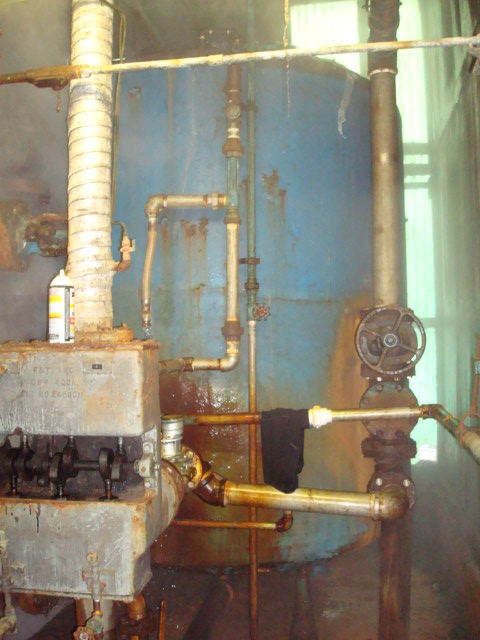
Res-Kem recently shipped an industrial water softener to a food flavorings plant in southern New Jersey.  The water treated by the water softener is used to make steam to sterilize the raw plant material prior to extraction and extract the flavoring.   The softener will be a replacement to an existing tank which has failed after 40 years of service.

System Operating Parameters:
Since most of the steam ends up in the plant matter and the extracted flavor ingredient, very little steam condensate is returned.  This make the makeup flow very large.  Each of the three softeners operate at 200 gpm and 80 psig.  Because to the system's age, corrosion of the tanks and piping have become a maintenance nightmare. 
An already existing industrial water softener
Existing Industrial Water Softener

New System:
The new system is an 84" diameter steel vessel and is finished in an epoxy coated interior and exterior.  The face piping is Schedule 80 PVC.  The valves are Bray valves with Bray air-to-air actuators.  The system is controlled by an Aquamatic 962 controller.  At this point, regeneration will be initiated manually when production will allow.  To handle the existing uneven floor, four jack legs were provided.
A new water softener before shipment to the Food and Flavorings Plant
New Water Softener prior to Shipment to Food and Flavorings Plant

Thursday, December 01, 2011

I Can't Believe It's Not A Water Sample!

Holy Moses! It wasn't 1 week after my last blog on October 28th 2011 about receiving water sample in old pickle jars when I get a water sample in an used margarine container!

A water sample shipped to Reskem in an old butter container
Water Sample Container Received by Res-Kem
P-L-E-A-S-E!. My disclaimer: "results not guaranteed for accuracy due to improper sampling container" Ok, the courtesy testing we do is of the non-critical, aesthetics only variety, however, I'm sure the old butter will skew my results. Now that the blue is leaving my face, please help a friend out and read my October 28th 2011 blog. Matter of fact, print it out and keep it in your shirt pocket or maybe tape it to the back door of your work van. Amen.

Monday, November 28, 2011

Validatable Water System for New Jersey Pharmaceutical Company Shipped

We were recently asked to provide a DI water system for a central NJ Pharmaceutical company. They required a small amount of water for a batching operation, 50 – 60 gallons per batch 3 to 5 batches per day. Their requirements were that the water would have to meet USP specifications and that the system would need to be validatable.

Reskem Water treatment and recirculation system on skid mounts
Res-Kem Skid-Mounted Water Treatment and Recirculation System
Being Prepared For Delivery
This was a perfect fit for one of our portable skid mounted, pre-plumbed and wired delivery systems. The system fabricated offered 5-micron pre filter cartridge, gallon totalizing meter, SDI exchange tanks, 1-micron resin trap filter cartridge to a 125-gallon storage tank complete with vent filter, spray ball assembly, and 3-way level control. The water would then return to the skid by way of a continuous duty recirculation pump where it would continue through a flow indication meter, bacteria control ultra violet, exchangeable polishing resin tanks and 0.20 micron absolute final filters before returning to the storage tank.

A storage tank made out of polypropylene that has a spray ball assembly being prepared for delivery
125 Gallon Sterile-Vented Polypropylene Storage Tank
With Spray Ball Assembly Being Prepared for Delivery
The customer also included an optional temperature control dump valve and resistivity monitor with two sensors. All this is controlled by an AB-Micrologx 1200 PLC. The entire skid with storage tank takes up less than 16 square feet of floor space and stands less than 6 feet in height.

To complete the package was all validation documentation to insure a seamless and quick turn over at start-up. This included P&ID, electrical schematics, and data required for IQ (Installation Qualification), and OQ (Operational Qualification).  This package was provided as both a hard copy and on a CD.  
A P&ID for a Reskem recirculation skid
P&ID For Res-Kem Recirculation Skid
Also, as an economical advantage, this system is not only portable but also expandable with very little expense so it will grow as the business grows.

Friday, November 18, 2011

Reduce Your Backwash Flow or Lament "Why is my ion exchange resin in the drain?"

It is that time of year.  You must reduce your backwash flow in the Fall or you will find your ion exchange resin in the drain or waste treatment plant.

Why do I need to reduce my backwash flow rate?
If the backwash rate for an ion exchange system is set when the water is warm, the flow rate will be too high when the water temperature is cold.  Anion resins are more susceptible to this problem because their densities are lower than cation resins.  Your ion exchange supplier should have curves of each resin in their literature.

A chart that shows an example of backwash flow rates
Example of Backwash Flow Rates and Bed Expansion Chart
Purolite C-100
For example, if a water softening system and therefore the tank are designed for a 50% bed expansion at 77F, the backwash flow rate will be about 6.5 gpm/sq ft for Purolite C-100 cation exchange resin.  If the temperature of the water decreases to 41F, the bed will expand 120% at that same 6.5 gpm/sq ft sending most of the resin down the drain.

Please note, each resin will have a different backwash rate, so look in the manufacturer's bulletins for the correct value.

How do I prevent this from happening?
  • If you have a backwash valve with a position stop, decrease the flow rate to the correct value at the colder operation temperature. 
  • 
  • If you have a backwash controller with rubber inserts, remove and plug enough holes to decrease the flow rate to the correct value at the colder operation temperature.
  • Some of the next-to-limitless flow controls and flow inserts that Res-Kem offers
    Some of the Numerous Flow Controls and Flow Inserts Offered by Res-Kem
  • Install a resin trap in the backwash line of the system.  If there is any media carry-over, it will be trapped, hence the name.

A resin trap that Res-Kem offers to keep resin from harming the environment
Res-Kem Manufactures Resin Traps for 2", 3" and 4" Piping to Prevent Resin and
Other Media From Contaminating Downstream Equipment
Need Help?:
Contact Res-Kem if you need help determining what needs to be done or to have us service you equipment.

Need Technical Information?
Flo-Controlet Flow Control Brochure Page 1 and Page 2

Tuesday, November 15, 2011

3D CAD Drawings for Condensate Polishers for University in Massachusetts

In order to speed installation of the condensate polishers we recently shipped to Massachusetts, Res-Kem was asked to provide 3D CAD files for the condensate polishers.  Here are some screenshots of these drawings.
A three dimensional representation of a Triple Condensate Polisher
Solidworks 3D CAD drawing of Triple Condensate Polisher
Why use 3D CAD?
Given the complexity of the installation, tight dimensions and tight timeline, the 3D drawing helps the mechanical contractors understand how the condensate polisher is assembled and needs to be installed.  Also, prior to receiving the system, the contractor can bring piping to the equipment saving on site installation time. 

In addition to the standard AutoCAD and Solidworks files we sent to the customer, we sent an executable file.  This allows anyone, with or without a CAD program, the ability to select any view and take dimensions off of the drawing.

A condensate polisher that can be used in your plant
Alternate view of 3D CAD drawing of Stainless Steel Condensate Polishers
Contact us for assistance sizing and selecting a condensate polisher for your plant.

Friday, October 28, 2011

Water Sampling a Critical Step in Residential Water Equipment Selection

For our wholesale equipment customers who treat well water, we offer a very basic water analysis. Ultimately, the success of the water treatment starts with proper sampling methods. We aren't talking rocket surgery here. Most residential water treatment systems can be prescribed by testing for 3-5 parameters, including hardness, pH, iron and Total Dissolved solids (TDS). However, what I find are samples collected in old pickle jars with little documentation. Most treatment companies will provide you with a clean sample bottle and a questionnaire, not pickle jar the home owner gave you.  If your customer wants an independent analysis, your customer can also find a certified laboratory in your State.

Critical questions for a questionnaire:
  • Is there an existing treatment system?
  • How powerful is the water pump?
  • How many bathrooms?
  • Any mega showers and Jacuzzi tubs? Irrigation?
  • Taste, odor, color?
Make as many observations as possible, listen to the homeowner. Part of your sample tool kit are your eyes, ears and nose. One of the best water observation tools are is a simple white Styrofoam cup. Fill it with water and see if there is any color or sediment. Always carry a washing machine hose and 5 gallon bucket. They make great sampling tools, especially if you are sampling from the well tank. Run off at least one five gallon bucket to clear the line.


LaMotte Color Q DW model 2059
 Of course you can forgo future brow beating and lectures from me if you purchase your own test kit and test the water yourself. You'll still need to ask the same questions above. Test kits range from mild to wild. We use the LaMotte Color Q DW model 2059. Now don't get excited. We don't sell test kits we sell the equipment after the test. If you get it right, every one's happy.

For additional information:
Certified water testing laboratories in your State
LaMotte Drinking Water Testing Products

Condensate Polishing System Shipped to University in Massachusetts

A triple all stainless steel condensate polisher was shipped to a university in Cambridge, Massachusetts.  The system is designed to treat 445 gpm of condensate and is replacing an existing unit which had reached the end of its life.  This is part of a major upgrade of the steam plant including the condensate polishers, a triple dealkalizer system, which Res-Kem will provide in November, and a deaerator.
A triple stainless steel condensate polishing system that Res-Kem offers
Res-Kem Triple Stainless Steel Condensate Polishing System
Here are the key features of the condensate polisher:
  • For long equipment life, the system has three, 54" ASME-code tanks manufactured in 304 L stainless steel. 
  • To simplify field installation, the system includes inlet, outlet, drain, backwash supply, brine and sub-surface wash headers.
  • The condensate polisher incorporates Bray 31 series butterfly valves with 92 series air open/air close actuators.
  • We supplied a custom designed FRP NEMA 12 panel with an Allen Bradley PLC with three solenoid boxes..
  • 304L stainless steel face piping.
  • Regeneration initiated via totalized flow or differential pressure.
  • The flow sensors to measure the treated condensate from each of the vessels were supplied by others.
  • The differential pressure switches are Orange Research 1203 DP transmitters with 4-20 mA output.
  • A subsurface wash is included to increase the time between regenerations increasing total energy efficiency.
  • A brine distributor for reduced salt usage
  • A separate source backwash is included to increase condensate heat recovery.
  • To prevent downstream damage, stainless steel resin traps are included in the treated water line.
A condensate polishing system that is in the middle of being off-loaded for a customer
Condensate Polishing System Being Off-Loaded at Customer's Site
Given the small space where the system is located, the standard design of the condensate polisher had to be re-engineered.  For example:
  • The three pressure vessels could not be evenly placed because a vertical support beam would be in the way making each header piece unique.
  • A height restriction required numerous engineering design iterations to get the system in the space allotted.
  • All headers needed to be nested in a very small envelop on the front of the system.
Additional information:


Condensate Polisher Checklist Webpage Version
Condensate Polisher Checklist - PDF Version
Condensate Polisher System Brochure
Need Applications Engineer


Tuesday, October 04, 2011

Ultra Filtration - The Membrane Problem Solver

There are very few innovations in the water treatment market these days. Sure the electronic controls have gotten more intuitive and compact, that is about it. Ion exchange hasn’t really made quantum leaps into the 22nd century either. So before I depress my fellow colleagues and influence young people to seek another career path, there is one exciting application of an innovation that really works. Ultra Filtration (UF). UF isn’t something new, but the membrane technology that makes it work has been refined and tamed over the years. For this Blog, I want to discuss its residential and light commercial applications as they relate to problem well water.
Ultrafiltration membrane fibers that have been magnified
Magnified Ultrafiltration Membrane Fibers

What is an UF filter?
For the uninitiated, a UF filter at first glance looks similar to a Reverse Osmosis membrane, only because it shares the same membrane housing. But that is where it stops. Same on the outside, vastly different on the inside. A UF filter is a bundle of tubes tightly bound together. A UF membrane system doesn’t require pumps and storage tanks like an RO. Depending on conditions your typical 4”x40” UF membrane can yield 7 gpm service water and require a backwash every 100-400 gallons of processed water. A UF will effectively filter down to .025 micron. .025 micron is where virus and cysts live! GONE!

What is a good UF application?
Basically UF’s are applied to water with color or sediments that are not being removed by conventional 1 micron or larger filtration, or sediment that takes days to settle out. In the past a professional would feed Alum into 120 gallon tank(s) to coagulate, precipitate, then filter. Quite messy and labor intensive. Now you can send the same water right through the UF membrane. The result is sparkling clear water. Let me rephrase that, AMAZINGLY clear water. Only use treated water to backwash a UF filter. Failure to use treated backwash water will cause the membrane to foul. Since the backwash cycle is only 30 seconds and uses only 3 gallons of water, most people add a large pressure tank (40 gallons with 15 gallon draw down) after the UF to act as the clean water storage. Short comings? What won't this membrane miracle handle? AVOID anything that "grows". Iron, manganese and sulfur bacteria for example could clog the membrane. Oil and grease is also a poor choice. Consider a UF on your next "murky" water job. Be AMAZED.

Composite Fiberglass Softeners Versus Lined Carbon Steel Softeners

Epoxy Coated Dual Tank Water Softener along with an Optional Stainless Steel Piping
Epoxy Coated Dual Tank Water Softener with Optional Stainless Steel Piping
Here are a few pro's and con's for a lined carbon steel softener option and a composite fiberglass softener system

Advantages of carbon steel lined softener system:
  • Lined carbon steel system has top man ways and side wall handholes. Having these access points to get to the resin bed and underdrain hub and lateral can be extremely helpful when changing the resin. Changing the resin can take place every 3-8 years and is contingent on chlorine levels in raw water. 
  • If the underdrain fails the lined carbon steel tank would stay in place with face piping left in-tact. The repairs could be accomplished from the side wall handholes. 
  • Lined carbon steel tank can resist being damaged with a passing forklift or other moving equipment 
  • If power fails and water pressure is still available, the unit can be generated manually. This is done by manually turning the pilot stager to each service cycle for the specified time in the step. 
  • If a temporary vacuum was ever introduced on a lined carbon steel tank it would likely not have any damages to the liner or tank. 
  • Higher flow rates can be achieved with lower pressure drops on 2" inlet/outlet 30" diameter carbon steel softener system versus a fiberglass system same tank diameter using a Fleck 2" 2900 valve
Disadvantages of a carbon steel lined system: 
  • Lined carbon steel pressure vessel softeners are more costly and more expensive to assemble
  • Longer lead times associated with these systems (4-8 weeks) 
  • Lined carbon steel tanks make for a lot of condensation and unlike fiberglass tanks aren't as resistant to corrosion even with a primed and painted exterior
  • Longer Lead Time to procure system components and to build the softener system
Example of a Manual Fiberglass Water softener
Manual Fiberglass Water Softener 
Advantages of a composite fiberglass tank softener system:
  • Lower cost materials to build the softener system 
  • A spare identical multi-port valve and control can be kept as a complete spare and be changed out in kind.
  • Shorter lead time. valves and composite fiberglass tanks are readily available. (1 - 3 weeks)
  • Pressure vessel is resistant to corrosion from tank condensation
Disadvantages of a composite fiberglass tank softener system: 
  • Can't withstand a vacuum being drawn on the tank. A lined composite fiberglass vessel under a vacuum would likely have a polyethylene liner failure. For this reason a vacuum breaker should be installed in a tee on the inlet water piping.
  • The piping needs to be supported by framework and the connections to the tank need to be flexible. 
  • On a fiberglass tank softener system if the hub and lateral needs to be changed the tank would have to be lowered down to the ground in order to reach in and replace the hub and lateral 
  • In order to change resin, the unions on the multi-port valve inlet, outlet and drain would need to be broken and the multi-port valve must be to unthreaded from the top of the tank. If this is done multiple times over a short period of time, the tank threads are prone to leaking
  • If seismic specifications are needed on the pressure vessels, fiberglass tanks shouldn't be selected 
  • If there is an electrical power failure the multi-port valve is not operable and the unit can't be regenerated
  • The commerically available controllers that are available with multi-port valve softeners are local only and integration with a PLC is not possible in most cases

Condensate Polisher Shipped to Arkansas

We shipped another condensate polishing system last month. This dual tank unit was shipped to a government facility in Arkansas.

a dual tank water condensate polishing system shipped to arkansas
Here are the key features of the polisher:
  • The system has two, 36" stainless steel, ASME-code tanks mounted on a skid to treat steam condensate.
  • The condensate polisher incorporates Bray 31 series butterfly valves with 93 series air open/spring return actuators.
  • We use a custom designed FRP NEMA 4X panel with an Allen Bradley PLC.
  • 304L stainless steel face piping.
  • Regeneration initiated via totalized flow or differential pressure.
  • Seametrics model IP101S flow sensors measure the treated condensate from each of the vessels.
  • The differential pressure switches are Orange Research 1201 series.
  • A subsurface wash is included to increase the time between regenerations increasing total energy efficiency.
  • A separate source backwash is included to increase condensate heat recovery.
Additional information:
Condensate Polisher system brochure
Condensate Polisher Checklist
Need Applications Engineer