Friday, August 12, 2011

300 gpm Industrial Water Softener Shipped to a Virginia University

Res-Kem's 300 gpm industrial water softener being prepared for shipment to a major Virginia university.
I nearly missed taking photos of a very nice looking quadruple tank industrial water softener that recently left our plant. As you can see, the system is being prepared for shipment and only two of the four tanks were available in this photo.

System Details:
The system has four 30" water softener vessels commonly called "mineral tanks". Each tank is rated for 75 gpm. The tanks are ASME code carbon steel tanks with a design pressure rating 100 psig.

Given the customizable standard designs we have for all of our water softening equipment and all of our industrial water treatment equipment, Res-Kem was able to accommodate the customer's request for carbon steel tanks with 304L stainless steel face piping. Bray series 21 butterfly valves with stainless steel body, 316 SS disc & stem, Teflon lined EPDM seat. Each of the automated valves were equipped with Bray series 70 electric actuators, two SPDT limit switches and a manual override handle.

Bray series 21 butterfly valves with stainless steel body, 316 SS disc and stem, teflon lined EPDM seat. The valves were equipped with Bray series 70 electric actuators with 2 SPDT limit switches and a manual override feature.
The internals of the tanks use stainless steel hubs and stainless steel wedgewire laterals for long life.
The internals of the Res-Ken industrial water softener tanks use stainless steel hubs and wedgewire laterals for long life.
The water softener system is being readied for shipment to our customer.

Res-Kem 300 gpm Quadruple Industrial Water softeners being prepared for shipment prior to tarping.
While our standard design uses the AquaMatic 962 controller, we offer as an option an Allen Bradley PLC. This system uses the Allen Bradley MicroLogix PLC with Panelview 600 operator interface terminal mounted in a NEMA 4X fiberglass enclosure was used to control the system.

Please contact us for further information on how to size a water softener for you requirements.


Friday, August 05, 2011

Peroxide. Mother Natures Hamburger Helper

As water treatment professionals we sometimes stumble upon jobs that are very troublesome. Those jobs almost always involve iron removal from ground water with oxidation. Oxidation is a tricky science. Your pH must be near neutral, but never above 8.2. High pH will cause the iron to create sludge. If you are using conventional air injection via venturi, pump or vacuum, you run the possibility of creating iron precipitate sludge. Also, barometric pressure, water temperature, and elevation greatly effect water's ability to hold oxygen.

Peroxide to the Rescue:
Now back to that pesky job leaking 0.5 ppm iron past your air fed iron filter where you've tried "everything". Peroxide to the rescue! What you are lacking is a good wallop of pure O2. 7% peroxide contains 70,000 ppm of oxygen. That will jump start your oxidation! Try it! You will be amazed. Your filter starts working and will nail that last bit of sneaky iron or sulfur . Peroxide works wonders for sulfur too.

For the wholesale market, we have built a complete package to treat water with iron and/or sulfur problems. It is called the Ultimate Oxidizer.

Extra Details you Need to Know:
Now I can continue on with a real snoozer of a post with all the minute details of "peroxification", but there are important peroxide application rules of the road.

  • Use 7% peroxide NSF rated with proper labeling. Any concentration greater than 7% will subject you to the scrutiny of regulators and lawyers.

  • Inject peroxide into the plumbing with a peristaltic pump, like Stenner or Chemtech XP.

  • Never dilute peroxide unless you use distilled, reverse osmosis, or deionized water. 7% peroxide should never need to be diluted, just adjust your pump's feed rate.

  • Store peroxide like a fine red wine: cool and dark.

  • A little peroxide goes a long way. Feed peroxide @ around 2 ppm per ppm of iron or sulfur. Feed into an in line mixer. a.k.a. static mixer, to gain optimal peroxide/water blending. No need for big blending tanks, peroxide works fast.

  • If the finished water turns white with micro bubbles you need to back down your feed pump. "if bubbles abound, turn your pump down". Peroxide is pure. It's just oxygen and water. No mystery ingredients like bleach. Plus with bleach, you run the risk of creating chlorinated by-products. This won't happen with peroxide. Dare I say peroxide is the "green oxidizer". Yup I dare.

Before You Start:
Please email me or call 800-323-1983 at ask for Michael Urbans.

Thursday, August 04, 2011

AquaMatic Valves-Normally Open or Normally Closed...That is the Question

One of the most confusing concepts of Aquamatic Valves is trying to determine from the customer if the valve is normally open or normally closed. What seems to confuse most customers when asked this question is how the valve functions on their system. For example, Res-Kem Water Softeners, for the most part, use a Normally Open Aquamatic Valve configuration. During the running process, the inlet and outlet valves are open allowing water to flow through the valves; whereas, a brine valve or a backwash valve is closed most of the time. Customers tend to interpret this to mean these particular valves are normally closed, and the inlet/outlet valves are normally open, but this is not the case at all.

That brings us to the question: what does Normally Open and Normally Closed mean when speaking about Aquamatic Valves. Aquamatic valves are controlled specifically by pressure. Even more so, line pressure from either water or air flowing into the valve, and control pressure, which comes from an Aquamatic Stager Controller or some type of solenoid. Lets take a look at how one can determine if their valves are normally open or normally closed.

So how does a Normally Open Aquamatic Valve work?
In the Aquamatic world, a Normally Open Valve means when water or air passes through the inlet side of an Aquamatic Valve, the Aquamatic Valve will open to allow the water or air to flow through it. More simply put, in a Normally Open configuration, line pressure opens the valve, and control pressure closes the valve.

So, the only way to close this valve is to apply control pressure into the Aquamatic Valve’s diaphragm chamber through the control port on top of the valve cap. This control pressure can be either water or air, and the pressure has to be equal or greater than the line pressure. Equal pressure will close the valve because the surface area of the diaphragm chamber is greater than the surface area of the inlet hole of the valve.

Here is a diagram showing the function of a Normally Open Valve:
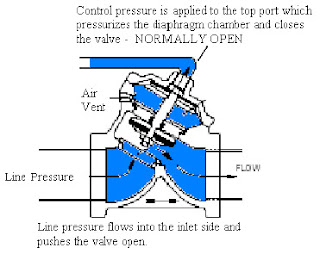


Normally OPEN AquaMatic diaphragm valve cross-section showing how the control pressure actuates the valve.

In looking at the diagram, water flowing into the valve, will open up the valve in a Normally Open valve configuration, and the control pressure applied to the diaphragm, chamber will close the valve. From a visual standpoint, if one sees a small tubing line connected to the top of the Aquamatic Valve’s cap, that is a good indication the valve is Normally Open.

So how does a Normally Closed Aquamatic Valve work?
A Normally Closed Valve means when water or air passes through the inlet side of an Aquamatic Valve, the Aquamatic Valve will close stopping the flow of water or air. Said another way, in a Normally Closed configuration, line pressure closes the valve, and control pressure opens the valve.

There is a shaft inside the Aquamatic Valves that holds the other parts in place. A Normally Closed Valve has a hollow shaft. The hollow shaft allows the line pressure, water or air, to flow up the shaft into the diaphragm chamber. This pressurizes the diaphragm chamber, which then push the parts down closing the Aquamatic Valve. A pipe plug is inserted in the port on top of the valve cap to keep the water or air pressure from escaping the valve. In order to open up this valve, control pressure is applied to a port that is typically located underneath the valve cap, which forces the valve in the open stage. Here is a diagram showing how a Normally Closed Valve functions:

Normally CLOSED AquaMatic diaphragm valve cross-section showing how the control pressure actuates the valve.

The best way to determine if the valve is normally closed is to see if a pipe plug inserted on the valve cap.

How can Res-Kem help me?
Hopefully, I have been able to explain the difference between Normally Open or Normally Closed AquaMatic valves. If not, we usually recommend you email pictures to me. Res-Kem also offers question forms with visuals to also assist.

AquaMatic K52 Series Question Guide
AquaMatic K530 Series Question Guide
AquaMatic V42 Series Question Guide
AquaMatic VAV Series Question Guide

Also look at our videos of how to select and repair AquaMatic valves.

If you have any questions, please email me, Mike Polito, or contact me for further assistance at 800-323-1983.

Monday, July 25, 2011

Activated Carbon-"That Old Black Magic"

Activated carbon is an amazing product. Its ability to purify and remove contaminants seems limitless. However, few people know what activated carbon really is or how it's manufactured. One of my go to articles on the subject, written by Calgon Carbon, is "Activated Carbon. What is it, How Does it Work".

What is activated carbon made from?
Just about anything organic can be reduced to its elemental carbon. We use the term activated because the organic material must be changed or carbonized to gain necessary pour structure to make it adsorb. Carbon manufacturers who serve the potable water and waste water markets found that coal, wood, and coconut char are the most suitable for the activation process.


How is activated carbon "activated"?
After the base material is selected an graded, it is sent to a huge furnace or "kiln" where it is blasted with 800 to 1000 degree heat. Through the miracle of science, and closely held cooking secrets, out pops the wonderful product known as activated carbon. Depending on the raw material used, finished carbon has a dry packed density from 27.5 to 33 pounds per cubic foot.


What should I look out for?
When purchasing activated carbon please remember quality can vary greatly. Garbage in, garbage out. Stick with a manufacturer or distributor you can trust. Also, since coal and coconut char are a commodity product, they are subject to to market supply and demand forces. Recently supply shortages have driven the price of coconut carbon up 35%.

Additional Information:
On our web site, we have posted an information bulletin titled Activated Carbon Principals. Enlighten yourself, you'll be glad you did. There are many other technical bulletins available on our site, please take a look!

Friday, July 22, 2011

Ion Exchange Resin Selection Guide

Product Selection Guide Via the Periodic Table copied from the Dow Water and Process website http://www.dowwaterandprocess.com/products/periodic_table
At Res-Kem, we routinely get requests to remove specific cations or anions from water. Many of then I know, but there are many I do not. The first place I always look is on the Dow website. I believe Dow has the most creative way to navigate through the numerous Dowex and Amberlite resins they have available. They use the periodic table of elements to graphically show you what standard cation, standard anion or selective ion exchange resin might work. The problem is the chart is buried within the site and if someone at Dow hadn't shown me it years ago, I never would have thought to look for it.

Clearly, this is just the beginning. You will likely need to bench test and pilot test before any equipment should be purchased.

Important Links:
The Dow Product Selection Guide Via the Periodic Table
The Res-Kem Resin Equivalency Chart.

Friday, July 15, 2011

Pentair NXT Electronics to the Rescue to a Field Customization Catastrophe

Recently, a customer called Res-Kem looking for assistance with troublesome Fleck 2900 valves at a car wash. The system was a hodge podge of "borrowed" components. There was a Fleck 2900 analog valve system 9, Autotrol 2" turbine meters, and a Autotrol 480 electronic controller. This set up was like someone putting a Ford motor, in a Chevy car, with Dodge transmission and expecting it all to work without any problems!

Solution:
Pentair NXT to the rescue! The new Pentair NXT electronics package is so adaptable we were able to economically convert the existing 2900 analog powerheads over to NXT powerheads (Res-Kem Part Number VLVFL29ULPHNXT). The conversion saved the customer from trashing otherwise perfectly operating 2900 valves and salvaged the existing 2" turbine meters. Astonishingly, the job was completed with no plumbing changes and only 1 hour of service disruption.

Pentair Electronic 3200 NXT controller as a replacement for an analog controller on a Pentair 2900 valve
Most valuable tid bit:
When using Non Pentair meters, program the NXT to accept the "generic" meter. You will need to input the max meter flow rate and pulse count. BTW, Autotrol 2" turbine is 250 gpm max flow and pulse count is 14.

Monday, July 11, 2011

Stenner Quick Pro Eliminates Black Finger Nails

Have you ever tried to change a peristaltic chemical feed pump tube? Without practice it was not a simple task. Tube changes usually resulted in pinched fingers and neglected maintenance. The Stenner pump company recognized the problem and recently released the Quick Pro pump head design. The Quick Pro allows you to collapse the "pinch rollers" and simply remove and replace the new tube. This video link shows how easy a Quick Pro tube change will be.

Have an old pump? The good news is you can retro fit old style tube housings with the Quick Pro. Just order part # PMPCMPQP10_ -1 . Add your tube number in the blank space after the QP10_-1. Upgrade your next tube change with Quick Pro.

If you have any questions, give us a call at 800-323-1983 or email us.

Friday, July 08, 2011

2011 B2B Marketing Conference Web Site Makeover

Res-Kem's web site was used as a case study at the B2B Marketing Conference last month. At the B2B Marketing Forum 2011, Res-Kem decided to take part in what was called a "MarketingProfs Makeover" of our website so we can "Optimize Your Website To Increase Search Visibility and Attract Qualified Visitors". Marc Engelsman, of Digital Brand Expressions, went through our website, blog and analytics to show where we are performing well and where we can improve.

Overall, our site received high marks! We are proud of our web site efforts to date. I hope you have seen the value as well!

To improve our site, Marc suggested we add more pages to our site by splitting up the existing content based upon keyword research and/or adding new pages of new content. Other ideas would be to take the information currently in our equipment PDF bulletin library, vast PDF library of MSDS and product bulletins, and case studies and make separate pages with this detail as well.

From our experience, we know we need to continuously improve our website and will need to add a social media angle to our efforts. We could use your help!

Please contact me at sales@reskem.com with any suggestions you might have to improve our website.

Thursday, July 07, 2011

Replacing Pentair Fleck Drive Motors or "HOW TO GET YOUR SPARK ON"

A field service person recently found that 24 volts and 120 volts don't mix. The hard way. Field service people should take great care to realize this when servicing/replacing Pentair Fleck valve drive motors commonly found on models 2750,2850,2900,3150, 3900.

Here is the golden rule: If the timer controls are Electronic (NT, NXT, XTR, SXT) the drive motors will be 24 volt. If the timer controls are analog (3200) the drive motors are 120 volt. The 24 volt motors are DC current and cylindrical in shape with a small capacitor at the end. The 120v motors are more square with a wound coil at the motor.

Thursday, June 30, 2011

GlobalSpec Condensate Polisher Presentation Archive

GlobalSpec now has easier access to presentation archives from their Virtual tradeshows. Here is the presentation Kevin Preising gave at the "Industrial Processing" event in August of 2010 entitled "Reuse the energy - don't lose it!"

Why should I view the presentation?
With fuel comprising 60-70% of the operating costs of a typical steam plant, dumping high BTU steam condensate down the drain costs you money. Treating and reusing condensate with a condensate polishing system pays for itself in 12-18 months. This presentation will detail the economics of sodium cycle condensate polishers.

FYI, you may have to register with Globalspec, but it is easy and free to do so.