
Res-Kem supplied, to a new nanotechnology center in Philadelphia, an ultrapure water system. The start up will commence this Monday. The system is designed to produce water with three different qualities to supply:
- 10 gpm to process cooling equipment
- 40 gpm to laboratory benches and humidification equipment
- 75 to 125 gpm to recirculation loop feeding process tools
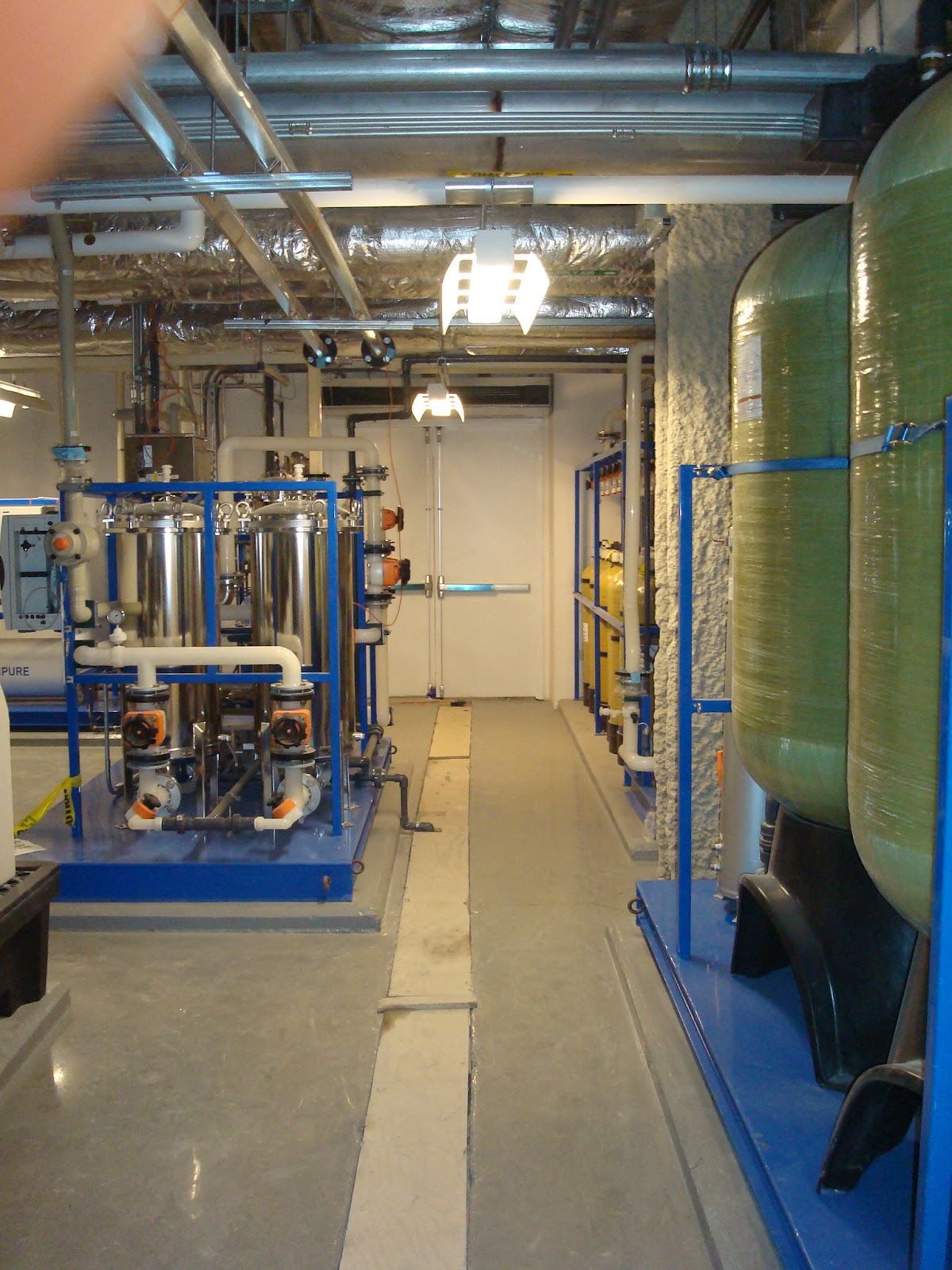 |
| Ultrapure Water System Produces a Maximum of 125 gpm of UPW |
Parameter
|
Specification
|
Measurement Location
|
Instrument or Analysis Method
|
|---|---|---|---|
Resistivity
(% of time)
|
< 18.2 M-ohm-cm
(100%)
|
On-line
|
Thornton 770 MAX
|
TOC
|
< 2 ppb
|
On-line
|
Sievers 500RLE
|
Dissolved Oxygen
|
< 5 ppb average
10 ppb maximum
|
On-line
|
Swan Oxytrace
|
Particles
|
< 80 particles/liter >=0.05 micron
|
On-line
|
PMS Ultra D150
|
Bacteria
|
< 1 CFU/liter
|
Off-line
|
Low nutrient agar
|
Al, Ca, Co, Cr, Cu, Fe, K, Mg, Na, Ni, Pb, Zn
|
< 5 ppt
|
Off-line
|
IC
|
Boron
|
0.1 ppb maximum
|
On-line
|
Sievers
|
Dissolved Si as SiO2
|
< 50 ppt
|
On-line
|
Swan
|
The system is designed to allow for easy expansion to double the makeup rate to the ultrapure water recirculation loop.
For more Information:
Contact us if you would like presentation about this project
Modular Ultrapure Water Systems
On-line Industrial Water Treatment Catalog